

Monthly Composer Playlists
Year B Composers Monthly Playlist
SEPTEMBER : CHOPIN
Frédéric Chopin (1810-1849) was born in Poland and recognized as a childen prodigy (“a second Mozart”). At the age of 7 years he wrote his very first piece of music and gave his first piano concert at the age of 8. Chopin wrote over 230 pieces, primarily for piano, including solo works, concertos, and chamber music. Click on the Playlist photo below to hear some of Chopin's most famous works.

november: GRIEG
Edvard Grieg (1843-1907) was born in Norway. He was a composer and pianist. He helped develop a national identity for Norway with the use of Norwegian folk music in his compositions. He was raised in a musical family and began playing piano at age six. He composed music for Henrik Ibsen’s play Peer Gynt and became one of his most familiar and loved music for orchestra, featuring Morning Song and The Hall of the Mountain King. Click on the playlist below to hear excerpts from Peer Gynt.

january: CHINESE MUSIC
Chinese music dates back thousands of years and is one of the oldest and most highly developed of all known musical systems. Chinese music sounds different from Western music with differences in tone, musical scale, instruments. It often uses instruments made from eight classifications of natural material including stone, clay, bamboo, metal, hide, silk, wood and gourds. A few of the classical instruments are the erhu (a two-string instrument), pipa (a four-string instrument), and dizi (a bamboo flute). Chinese music is often inspired by nature, stories, celebrations, and everyday life. Different regions of China have their own styles of folk music, making it very diverse. Enjoy listening to the playlist below of Chinese folk music.

march: viLLA-LOBOS
Heitor Villa-Lobos, (1887-1959) was born in Brazil. He was one of the foremost Latin American composers of the 20th century. His compositions combined indigenous melodic and rhythmic elements with Western classical music. He learned to play cello at age six and was inspired by music from JS Bach. He later learned to play the guitar. He composed about 2,000 works in every form, from solo pieces for guitar to trios, quartets, concerti, vocal music, and symphonies. Villa-Lobos’s works are characterized by a unique blend of Western classical music and Brazilian folk songs and rhythms.

may: bRAHMS
Johannes Brahms (1833-1897) was born in Germany. He grew up in a musical family and began writing music at the age of six. He learned to play violin, cello and piano. He is considered on of the big “Three B’s” of the classical music world along with Bach and Beethoven. He was a virtuoso pianist, conductor and composer. He composed for symphonies, chamber ensembles and solo instruments. The sweet melody of Brahm's Lullaby or Cradle Song (Wiegenlied) is a timeless piece of classical music and has soothed countless babies to sleep.

october: HOLST
Gustav Holst (1874-1934) was born in England. He earned his living as a composer, music teacher and playing the trombone. He is best known for his orchestral suite, The Planets. The Planets represent the most of the known planets of the Solar System at the time of his writing. Each planet has a whole piece of its own. Holst uses a big orchestra with many added instruments. Click on the photo below to hear The Planets and other of Holst's most well-known works.

december: DEBUSSY
Claude Debussy (1862-1918) was born in France. Debussy started piano at a young age and studied at the Paris Conservatory at the age of 10. He was fascinated by visual art and the new style called “Impressionism.” Debussy applied the idea of Impressionism to music. He produced unique new sounds and sonorities with his composition also influenced by Indonesian music called Gamelan music with bells, gongs and xylophones. Listen to the Spotify playlist below to hear some of Debussy's most well-known works.

february: SHANKAR
Ravi Shankar (1920-2012) was born in India. He was an Indian sitarist and composer. He was influential in expanding the appreciation of classical North Indian music. He composed ragas, film scores (including the biopic of Mahatma Gandhi), and symphonic works. He influenced many musicians in India and throughout the world, including George Harrison, the lead guitarist of the Beatles. Listen to the Spotify playlist of some of Shankar's famous works by clicking on the photo below.

april: AFRICAN MUSIC
The continent of Africa and its music is vast and diverse. Many countries throughout Africa maintain their own distinct musical traditions. African music in general is highly rhythmic, with complex rhythms played against one another to create "polyrhythms" common to African music. The African traditions rely on a wide variety of percussion instruments such as drums, rattles, djembes, xylophones and mbiras (thumb pianos). Singing is also central to many traditions with a call-and-response feature. Traditional music is passed down through oral tradition and plays an integral part of communal life, religion and rituals. African musical traditions have had an influence on in shaping music outside of Africa in the United States with Dixieland, blues and jazz.

Year A Composers Monthly Playlist
SEPTEMBER : Mozart
Wolfgang Amadeus Mozart (1756–1791) was a prolific and influential composer. He was a child prodigy who began proficiently performed on violin and keyboard and began composing all by the age of 5. He composed more than 800 works including piano concertos, string quartets, symphonies, operas, and sacred music. Click on the Spotify Playlist below to listen to some of his greatest works.

november: dvořák
Antonin Dvořák, Czech composer (1841–1904), wrote the New World Symphony in 1893 while he was the director of the National Conservatory of Music of America from 1892 to 1895. Notably he spent a summer in Spillville, Iowa, where he drew inspiration from nature, composing String Quartet No. 12 in F Major and the String Quintet No. 3 in E flat major. Click on the Spotify Playlist below to hear the New World Symphony (No. 9), as well as a few other well known works by Dvořák.

january: handel
George Frideric Handel (1685–1759) was a German-British Baroque composer well-known for his operas, oratorios and organ concerti. Handel's Water Music was commissioned by King George I as entertainment for for a royal cruise on the River Thames. Handel’s 'Water Music' is a series of lively orchestral movements, many of which are based upon dances such as the minuet, bourrée, hornpipe, sarabande, gigue and rigaudon.

march: vivaldi
Italian composer and violinist Antonio Vivaldi (1678–1741) is celebrated as one of the greatest composers of the Baroque era. One of his most famous work, "The Four Seasons," consists of violin concertos each representing one season of the year.

may: beethoven
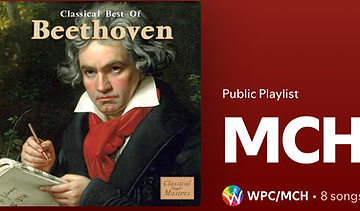
Ludwig van Beethoven (1770–1827) was a German composer and pianist, and is also considered one of the most revered figures in the history of Western music. At the age of 26 Beethoven began to lose his hearing and was completely deaf by the age of 45, but continued to write music his entire life. He wrote 722 works over his life span. Enjoy the Spotify Playlist of some of Beethoven's greatest works.
october: st. saëns
Charles-Camille Saint-Saëns (1835-1921) was a French composer, organist and conductor who wrote works including Carnival of the Animals written as a humorous piece written for friends and family. Carnival of the Animals did not become well known until 30 years after his death. Listen to the Spotify Playlist below to hear the 14 movements of this whimsical chamber music work.

december: tchaikovsky
Russian composer Pyotr Ilyich Tchaikovsky (1840-1893) wrote some of the most popular concert and theatrical music in the Classical repertoire, including the ballets Swan Lake, Sleeping Beauty and The Nutcracker, and the orchestral work 1812 Overture. Interestingly he began writing music at the very young age of 4 and began piano lessons at age 5. Click on the Spotify Playlist below to enjoy listening to The Nutcracker.

february: ravel/haydn
Maurice Ravel (1875–1937) French composer, pianist and conductor. Mother Goose is a suite five-movement featuring Sleeping Beauty, Tom Thumb, and Beauty and the Beast. Austrian composer Franz Joseph Haydn (1732–1809) was instrumental in the development of chamber music. He was called "Papa" by his close friends, who loved his generous nature and humor. Enjoy listening to the Spotify Playlist of Ravel's "Mother Goose Suite" and Haydn's "Surprise Symphony."

april: bach
Johann Sebastian Bach (1685–1750) was a German composer and musician of the late Baroque period. He is considered one of the greatest composers of all time including the orchestral Brandenburg Concertos; solo instrumental works such as the cello suites and sonatas for solo violin; keyboard, organ and choral works. Bach was the father to 20 children, with several becoming well known musicians and composers. Enjoy listening to the Spotify Playlist featuring some of his most well- known works.

Year A Composers Monthly Playlist